Home > Health > Sleep > Why You Wake at 3 AM
Why You Keep Waking Up at 3 AM
It’s not stress, and it’s not age. It’s the 3 AM cortisol spike — and the mineral that switches it off.

- Sources cited
- Advertiser disclosure
You do not wake up at random. You wake up at almost the same time, night after night — and that is the part nobody explains.
For years I told patients it was stress, or age, or screens. Then I started looking at what their bodies were actually doing at that hour. What I found changed how I treat broken sleep — and it is the reason heavier sleep aids, bigger melatonin doses, and one more “perfect” bedtime routine may never give you lasting relief. None of them touch the signal that is waking you.

The Problem Is More Serious Than You Think
Every week in my sleep clinic, I hear from exhausted adults who have tried everything their doctors, friends, and late-night internet searches recommended.
They have spent hundreds — or even thousands — on sleep aids, mattresses, supplements, meditation apps, blackout curtains, and complicated bedtime routines.
Yet they still find themselves wide awake at 3 AM, staring at the ceiling while the person beside them sleeps peacefully.
They all tell me some version of the same story:
“Nothing works anymore. Something may help for a few nights, but then I’m right back where I started. Now I’m tired, frustrated, and worried I’ll never sleep normally again.”
Here is what most people are never told:
The problem is not necessarily that you need something stronger.
The problem is that you may be treating the moment you fall asleep — without supporting the system that is supposed to keep you asleep.
Your sleeplessness is not only about bedtime. It may be a sign that your brain’s natural sleep-pressure system is no longer doing its job properly.
Kate’s Story
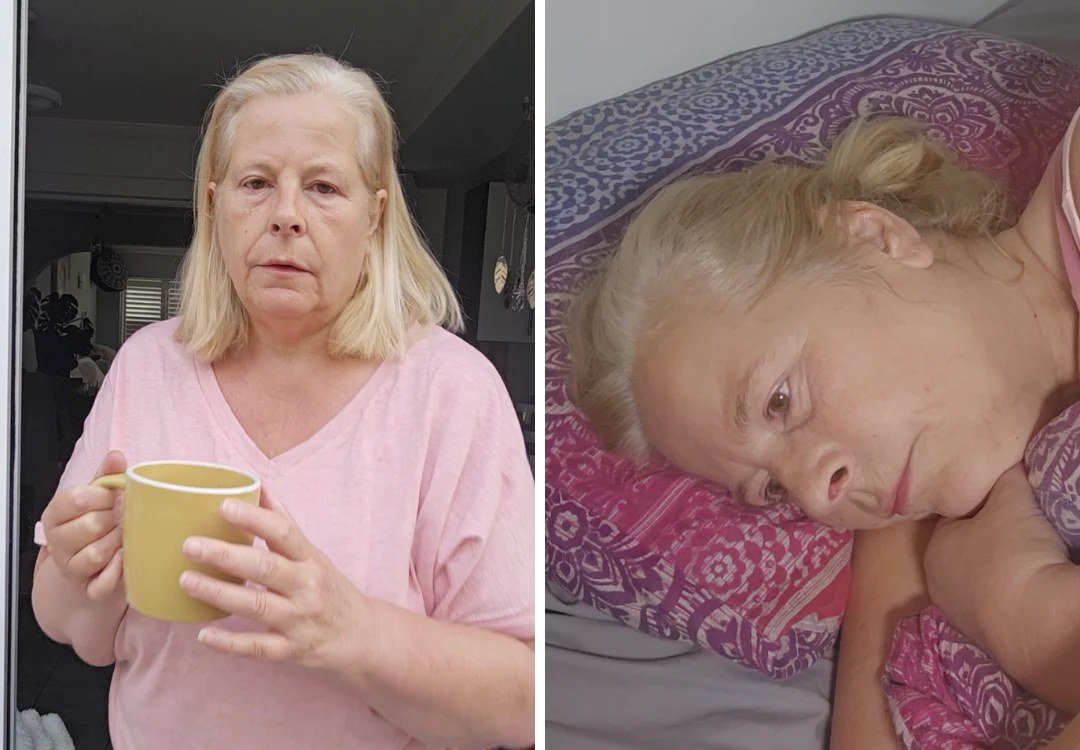
Last month, a patient named Kate sat in my office, visibly exhausted. At 62, she had been struggling with broken sleep for almost four years.
“Dr. Spencer, I’ve tried everything. Something works for a few days or weeks, but then it stops. I’m spending more money, increasing doses, and feeling worse during the day. I don’t know how much longer I can keep doing this.”
Kate handed me a list of nearly everything she had tried. The total surprised even her.
What She Had Tried
- ZzzQuil: $18 monthly — for a year: $210
- Ambien prescription: $32 monthly
- Melatonin supplements: $61
- Sleep meditation apps: annual subscription $81
- Chamomile and valerian teas: $40
- “Sleep hygiene” upgrades (blackout curtains, white noise machine): $202
- New “orthopedic” mattress: $1,077
- Private sleep consultation online: $269
Total spent: more than $1,900.
Result: still waking up at approximately 3 AM almost every night.
The worst part was that several solutions appeared to work at first. They gave her hope. Then the effect faded, leaving her more frustrated than before.
Her sleep problems were also creating new daytime problems:
- Morning grogginess
- Difficulty concentrating
- Irritability
- Memory lapses
- Dependence on coffee just to feel functional
- Anxiety every evening about whether she would sleep
She was no longer simply tired. She had started dreading bedtime.
Kate’s mistake cost her $1,900. See what she uses now — 64% off today
Why All These Solutions Fail (And Why Almost Nobody Explains It)
The uncomfortable truth is that many popular sleep solutions focus on making you feel drowsy. But feeling drowsy is not the same as supporting the natural system responsible for deep, continuous sleep.
That is why something may help you fall asleep for a few nights… yet still leave you awake at 3 AM, watching the clock and wondering why it stopped working.

Prescription Sleeping Tablets — Including Ambien and Lunesta
Prescription sleeping medications may help some people fall asleep, but they generally work by suppressing alertness. They do not necessarily support the natural sleep pressure your brain is supposed to build throughout the day.
This helps explain why someone may fall asleep but still:
- Wake during the night
- Feel unrested in the morning
- Experience mental fog
- Need ongoing medical supervision or dosage adjustments
They may help switch you off temporarily. But that is not the same as helping your body maintain natural, restorative sleep throughout the entire night.
Over-The-Counter Antihistamines — Including ZzzQuil and Unisom
Many common nighttime products rely on antihistamines that produce drowsiness as a side effect. They may make your eyelids feel heavy, but they were not designed to support the complete biological process behind natural sleep.
For many people, the result is a night that feels artificially induced followed by a morning filled with heaviness, mental fog, and the feeling that the sleep did not truly restore them.
Melatonin Supplements — Especially Higher Doses
Melatonin is primarily a timing signal. It tells your brain that darkness has arrived. But it does not automatically quiet racing thoughts, release physical tension, rebuild sleep pressure, or support calm throughout the entire night.
Imagine turning off every light in your house while the television, appliances, alarms, and notifications are still running. The room is dark. But the system is not quiet.
That is why someone may feel sleepy at bedtime, then snap awake three or four hours later with their mind fully switched back on. The signal for nighttime was there. But the rest of the sleep system was still unsupported.
Basic Magnesium Supplements Alone
Magnesium can support relaxation. But a basic, single-ingredient magnesium supplement — especially one that is not formulated as part of a complete nighttime system — does not necessarily address every factor involved in broken sleep.
By itself, it may not fully support:
- Racing thoughts
- GABA-related calm
- Serotonin and melatonin pathways
- The cofactors needed to use those pathways effectively
- The gentle timing signal that tells the body bedtime has arrived
- Continuous support throughout the night
The intention is right. The system is simply incomplete. That is why Magnesium Bisglycinate can be a valuable foundation, but it works differently when combined with complementary ingredients designed to support the entire sleep cycle.
Herbal Teas
Chamomile, valerian, lemon balm, and similar botanicals have long been associated with relaxation. But a cup of tea may not provide the complete, precisely coordinated support needed by someone whose sleep has been broken for months or years.
It may help create a calming ritual. But a calming ritual alone may not be enough to recharge natural sleep pressure, quiet an overactive mind, release physical tension, and support sleep continuity until morning.
The problem is not always the ingredient itself. Sometimes it is the form, amount, timing — and the absence of complementary support.
That is why the real solution cannot focus only on making you drowsy. It has to support the complete sleep system.
Here’s Where You’re Getting It Wrong

After reviewing the habits of people with long-term sleep problems, three misunderstandings appear again and again.
Misconception 1: “I Just Need Something Stronger.”
More sedation does not automatically equal better sleep. You are not simply looking for something powerful enough to knock you unconscious. You are looking for a system that helps:
- Recharge your natural sleep pressure
- Quiet mental noise
- Release physical tension
- Signal that bedtime has arrived
- Support continuity throughout the night
The goal is not just to lose consciousness. The goal is to experience restorative sleep.
Misconception 2: “I’m Just Stressed. Once Life Calms Down, I’ll Sleep Normally.”
Stress may have started the problem. But after months or years of broken nights, the pattern can begin repeating even on relatively calm days.
Your body becomes accustomed to carrying alertness into bed. The second your head touches the pillow, your mind begins scanning:
- What did I forget?
- What needs to happen tomorrow?
- Did I answer that email?
- What if something goes wrong?
- How many hours are left before morning?
Reducing daytime stress is useful. But it may not be enough to rebuild the nighttime system that has been repeatedly disrupted.
Misconception 3: “This Is Just What Happens When You Get Older.”
Sleep patterns can change with age. But waking night after night with a fully alert mind should not automatically be dismissed as something you must simply accept.
Feeling physically exhausted while remaining mentally wide awake is a sign that different parts of your sleep system are no longer working together as smoothly as they once did.
Check today’s Sonnus® availability — free shipping, 90-day guarantee
The Science Behind Broken Sleep: What’s Really Happening

Your brain has a natural system that is supposed to make sleep feel increasingly automatic as the day progresses. Think of it as a sleep battery.
Every minute you remain awake, your brain builds natural sleep pressure, largely associated with a molecule called adenosine. By bedtime, that pressure should be strong enough to help you:
- Feel naturally sleepy
- Drift off without fighting your own thoughts
- Remain asleep
- Move through the deeper stages of restorative rest
But for millions of adults, two major forces interfere with that process.
The 3 AM Cortisol Spike
Chronic stress keeps your nervous system in alert mode. Even when your body is tired, your brain may continue scanning for problems, rehearsing conversations, and preparing for tomorrow.
But here is the part almost nobody explains — and it is the reason your clock keeps showing you the same number.
Cortisol, the body’s main stress hormone, is not supposed to stay flat all night. It follows a curve. It falls to its lowest point around midnight, then begins climbing again in the early morning so that you can wake up. That climb is meant to be gradual, and it is meant to begin near dawn.
When cortisol has been running high for months or years, that curve can shift. The climb starts earlier, and steeper. And your body then does exactly what it was built to do when cortisol rises: it wakes you up.
That is what I call the 3 AM cortisol spike. It is not insomnia in the ordinary sense. You are not failing to fall asleep — you are being woken on schedule, by a signal that arrived hours too early.
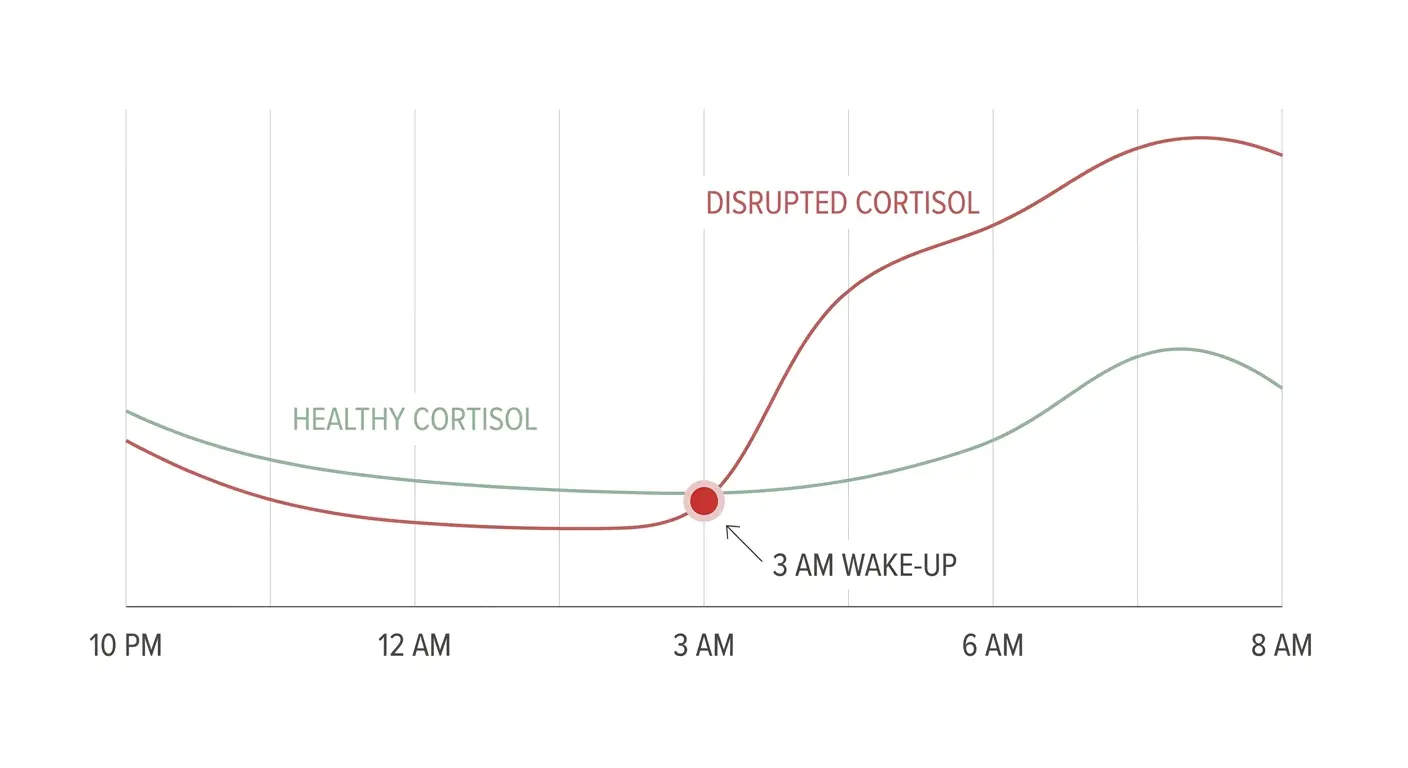
It also explains the detail that confuses people most: feeling physically exhausted and mentally wide awake at the same time. The body is tired. The alarm system is not.
And this is where the mineral most people are already taking — usually in the wrong form, and at the wrong hour — becomes relevant. Magnesium is among the nutrients most closely associated with the pathways involved in that stress response. Which is why a basic magnesium tablet swallowed at random can miss the mark entirely, while the right form, taken at the right time, may support a very different night.
See the magnesium form Sonnus® uses — and today’s availability
Modern Overstimulation
Caffeine, blue light, notifications, late-night scrolling, work emails, and constant mental stimulation can make your brain behave as though the day never truly ended.

When your sleep battery does not fully charge, something maddening happens: you feel physically exhausted… yet remain mentally wide awake.
At the same time, your nervous system may struggle to transition from its active state into a calmer, rest-oriented state. This can contribute to:
- Persistent mental activity
- Physical tension
- Difficulty drifting off
- Repeated nighttime awakenings
- Waking around 2 or 3 AM with a fully alert mind
- Feeling foggy despite spending seven or eight hours in bed
Traditional sleep aids may temporarily suppress awareness. But they do not necessarily recharge the underlying sleep battery or coordinate all the pathways involved in calm, timing, tension release, and sleep continuity.
The lights went off. But the battery was still empty.
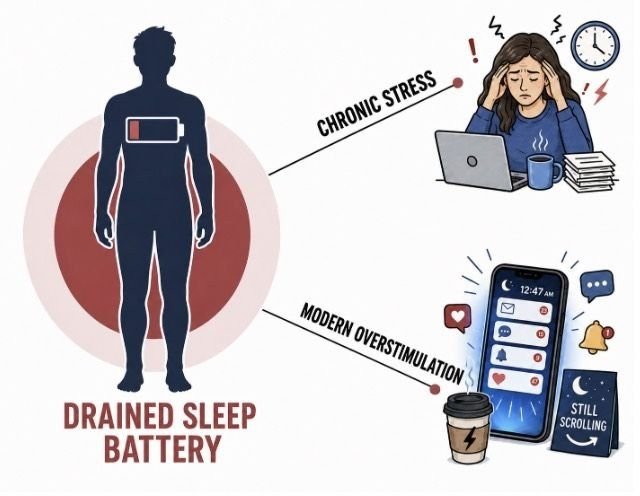
The answer is not always to sedate yourself harder. The answer may be to support the whole sleep system.
How to Actually Solve the Problem: We Must Address the Root Cause
The answer is not necessarily:
- A stronger sleeping pill
- A larger melatonin dose
- Another new mattress
- A stricter nighttime routine
- One isolated ingredient
The goal is to help your brain and body remember how to move from alertness into calm, and then remain supported throughout the night.
To understand how, there are two broad requirements for natural, continuous sleep.
Requirement 1: Initial Calming
Your mind and body need to receive the signal that the day is over. Mental noise needs to slow. Physical tension needs to release. Your brain needs to ease out of alert mode instead of carrying tomorrow’s problems into bed.
Requirement 2: Sustained Nighttime Support
Feeling calm for the first 20 minutes is not enough. Your sleep system must remain supported after you drift off — especially during the hours when many people suddenly surface and check: “Is everything still okay?”
This is where many approaches fall short. A high-dose melatonin product may provide a timing signal, but not the rest of the system. A single herb may promote relaxation, but not provide the cofactors behind natural nighttime signaling. A basic magnesium product may help the body relax, but not fully quiet mental noise or support sleep continuity.
This is why so many people can fall asleep… and still wake up at 3 AM.
Sonnus®: A Complete System Designed to Address Both Requirements
In cases where basic, single-ingredient approaches have fallen short, Sonnus® offers a fundamentally different strategy.
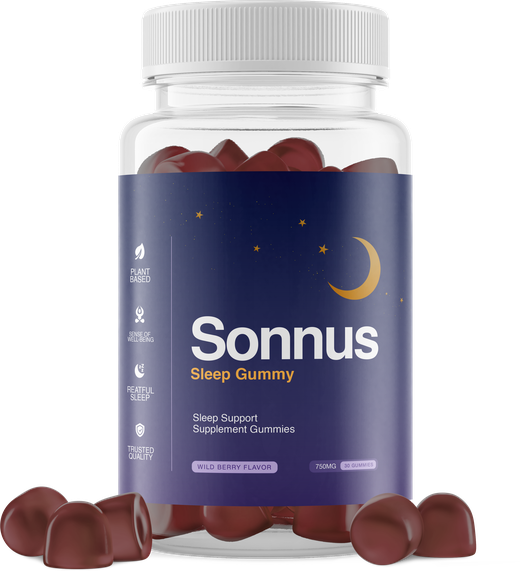
Sonnus® is a wild-berry sleep gummy built around a ten-ingredient nighttime system. Instead of depending on brute-force sedation or a melatonin megadose, it is designed to support the biological pathways behind:
- Natural sleep pressure
- A quieter mind
- Physical relaxation
- Gentle nighttime signaling
- Deeper, more continuous rest
At the foundation of the formula is Magnesium Bisglycinate, positioned as the Sonnus® Sleep-Pressure Primer. But Sonnus® does not ask magnesium to perform the entire job alone. It combines it with nine complementary ingredients in the Sonnus® 4-Step Reset.
The Sonnus® 4-Step Reset
Step 1: Recharge
Magnesium Bisglycinate + 5-HTP + B Vitamins. This stage supports the raw materials and cofactors involved in natural nighttime signaling. Magnesium Bisglycinate forms the foundation, while 5-HTP and B vitamins support pathways associated with serotonin and melatonin metabolism.
Step 2: Quiet
L-Theanine + GABA + Apigenin. This stage is designed to support a quieter mental state. L-Theanine supports calm alpha-wave activity. GABA acts as the brain’s natural “brake pedal.” Apigenin, a compound associated with chamomile, supports GABA-related calm.
Step 3: Release
Magnesium Glycinate + Lemon Balm. This stage supports physical relaxation. It helps the body move from feeling tense and wired toward feeling relaxed and ready for rest.
Step 4: Restore
Precision Melatonin 0.9 mg + Full-System Support. Sonnus® uses a precise 0.9 mg melatonin signal. Not the common 5, 10, or 12 mg megadose. It acts as a gentle signal that bedtime has arrived — while the rest of the formula supports the broader sleep system.
A whisper, not a sledgehammer.
Do all four together, and sleep no longer depends on one ingredient trying to perform every job.
See If Sonnus® Is Still In Stock — 64% Off Today
Here’s What Happens When You Take Sonnus®
About 30 Minutes Before Bed
Chew two wild-berry gummies. There are no large tablets, bitter teas, powders, or complicated preparations.
As Bedtime Approaches
The complete formula begins supporting relaxation, mental calm, physical tension release, and nighttime signaling. Instead of fighting your own head, drifting off may begin to feel less like a nightly battle.
During the Night
The system is designed to support more continuous rest — not merely the first few minutes after you close your eyes. If you briefly stir, the goal is to help you roll over and return to sleep rather than becoming fully alert and reaching for the clock.
The Following Morning
Because Sonnus® is not built around a high-dose melatonin approach or prescription sedative, it is designed to support clearer, more refreshed mornings instead of a heavy sleep-aid hangover.
Individual experiences vary, and consistent nightly use is recommended.
The Ingredients Behind the System
- Magnesium Bisglycinate
- Magnesium Glycinate
- 5-HTP
- L-Theanine
- GABA
- Apigenin
- Lemon Balm
- Vitamin B6
- Vitamin B2
- Melatonin 0.9 mg
Why This Approach Is Different From Basic Sleep Aids
It Does Not Depend on One Ingredient
Sonnus® combines ten complementary ingredients rather than expecting melatonin, magnesium, or one herb to handle the whole sleep cycle.
It Uses a Precise Melatonin Signal
The formula contains 0.9 mg of melatonin instead of building the product around a common high-dose approach.
It Supports More Than Falling Asleep
The system is designed to support natural sleep pressure, mental calm, physical relaxation, bedtime signaling, and sleep continuity.
It Is Not Designed as a Harsh Knockout
Sonnus® supports natural sleep pathways. It is not positioned as a prescription sedative or a product intended to force unconsciousness.
It Is Designed for Clearer Mornings
The goal is restorative rest without waking up feeling as though you still need to “shake off” the night.
It Is Third-Party Tested
According to the product materials, Sonnus® is made in the USA in an FDA-registered facility, and batches are third-party tested for purity.
See If Sonnus® Is Still In Stock — 64% Off Today
ACT NOW: This Batch Is Already Moving
I need to be direct with you. Products containing multiple specialized ingredients can require more complex production than basic, single-ingredient sleep gummies. During high-demand periods, certain batches or promotional quantities may sell out.
The good news is that if you are still seeing the official order page active, units may still be available.
Every night you wait can mean another night spent:
- Tossing and turning
- Watching the clock
- Feeling exhausted but mentally awake
- Waking foggy
- Relying on coffee to feel functional
- Dreading bedtime before the evening even begins
The longer broken sleep continues, the more it can affect your energy, patience, focus, and ability to feel present during the day.
Exclusive Offer For Readers
IMPORTANT: If you’re still seeing this message, it means the special offer is still active.